


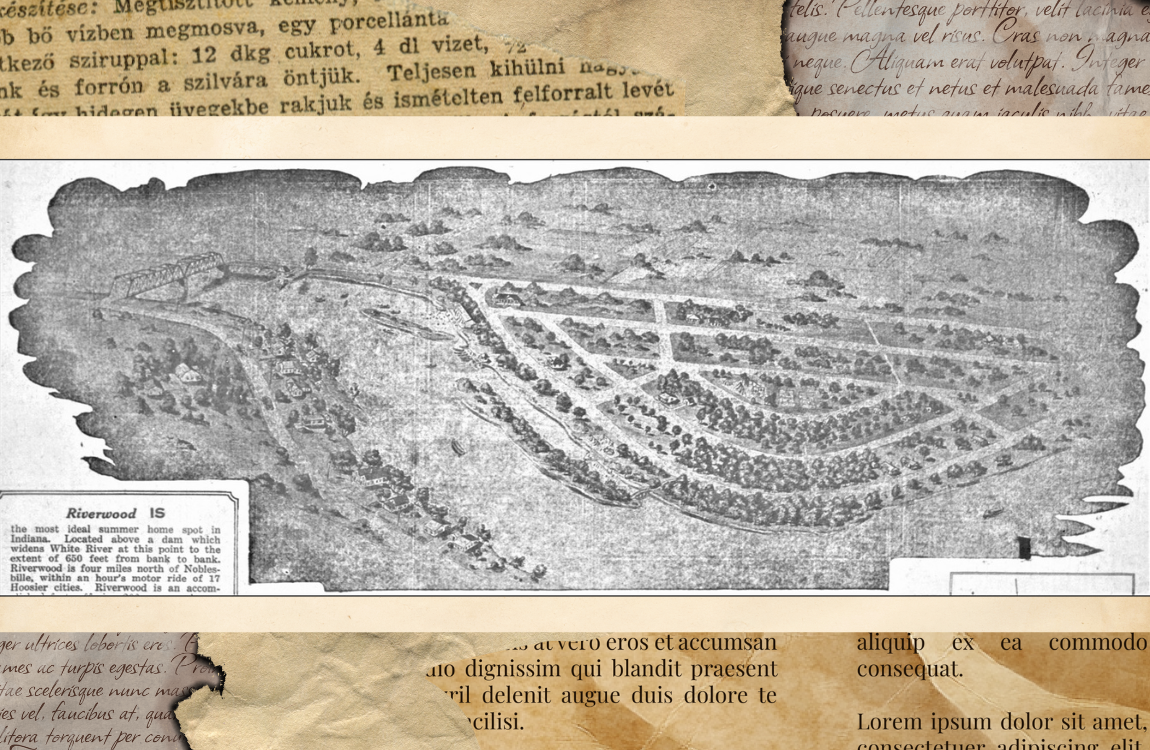
This is another part of Hamilton County’s history with steamboats. Many people probably remember the various excursion boats on Morse Reservoir – the “Morse Queen” in 1965, and the “Waterfront Queen” / ”Star of Cicero” which ran in the 1990’s and 2000’s. Hamilton County had another boat that preceded them and which ran more than twenty years before Morse Reservoir was even constructed.
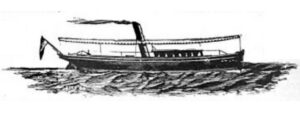
Generic Steam Launch
It came about because of the creation of the area called Riverwood in 1922 by the Holiday Hydroelectric Dam. This area had been used for mills for a century before this. The first mill may have been constructed by William Foster around 1820. It was a grist mill with a dam made from brush wood and was eventually owned by William Conner. The land surrounding the mill was not purchased from the government until 1832, when it was bought by Elijah Redmon and Bicknell Cole.
William Conner’s son, W. W. Conner, built a woolen mill in this area in 1845. It was damaged a few years later during one of the great floods. Smaller floods and freshets were constantly damaging the mill dam. The mill had been rebuilt into large five-story building by 1866. By 1874, an entire milling complex had grown up with a grist mill for both wheat and corn, a woolen mill, and a saw mill. The millrace for these buildings had been cut into the solid limestone bedrock. A solid wooden dam was probably in use by this time. The village that had grown up around the milling complex established a post office in 1878 and named itself Clare.
However, by this time, steam power was allowing mills to be built closer to towns and railroads. In Noblesville in the 1890s, the giant Model Milling Company complex was built by the Marmon family. Clare was no longer a convenient place to bring crops. The group of structures were abandoned and neglected. The Clare post office closed in 1902. In 1908, the remaining buildings of the old mill were torn down and the wood reused for a hydroelectric dam project near Noblesville – which eventually failed.
In 1922, Alex Holliday, an MIT-trained engineer and son of the man for whom Holliday Park in Indianapolis is named, surveyed the site of the old mill complex and decided it would be a good spot for another try at a hydroelectric dam. This one was successful, which led to the construction of the community at Riverwood.
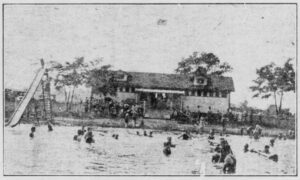
Riverwood Beach House
The community was designed to be a resort. Summer cabins were built, some of which were quite luxurious. A bathing pool was dug into the western bank creating an island to separate it from the river and loads of beach sand were spread on the shore. The Riverwood Café and the Fleming Store were established to provide amenities. The Downing family built a seventeen-room house which became the Lagoon Lodge in 1929 and still stands at River Bend campground.
Then in 1925, a newspaper article made an offhand remark that there was also an excursion boat. Named “Summer Girl”, she was run by the Smith & Evans Company of Muncie. Richard “Dick” Smith and Herbert Evans both had summer cabins at Riverwood. There are no images or detailed descriptions of the boat, but news accounts describe her as a steam launch that could carry 60 passengers and had room for a piano. A searchlight was added later for night trips.
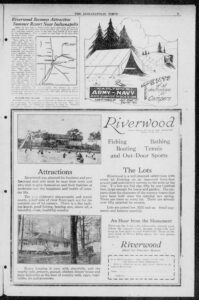
The Indianapolis Times
She had a sister ship named “Isabelle” whose mooring ropes broke during high water in March of 1927 and disappeared over the dam. “Isabelle” may have either broken up and sunk or was salvaged and taken to pieces. There is no report that the ship was ever found and her actual fate was unknown.
“Summer Girl” was very popular and used as a base for public events like concerts and church services. Primarily however, she made many cruises for people to enjoy the cooling air. She would leave her wharf on the western bank and head up the river to make a three-mile round trip. Occasionally a three- or four-piece musical group would provide entertainment.
The boat was Involved in a bank scandal in 1928. Omar G. Patterson had been embezzling money from the Noblesville bank where he worked and used it for parties at Riverwood. One of those parties involved chartering “Summer Girl” and having a cruise for Noblesville’s “best people”. Patterson had embezzled $147,100 by the time he was caught.
A second boat named “Slo Poke” was launched in August of 1929, but the Great Depression eventually brought an end to the halcyon days of the resort. The last mentions of “Summer Girl” came in 1932. A June newspaper article said that a Mr. Goffer of Elwood had leased the boat to turn it into a houseboat. However, another paper reported a church group had taken a cruise in July. This was happening at the same time that speedboat races were beginning in the area, which brought in a different kind of crowd.
Whatever the final fate of “Summer Girl” was, she had brought a great deal of enjoyment to the community and was a source of pride.