


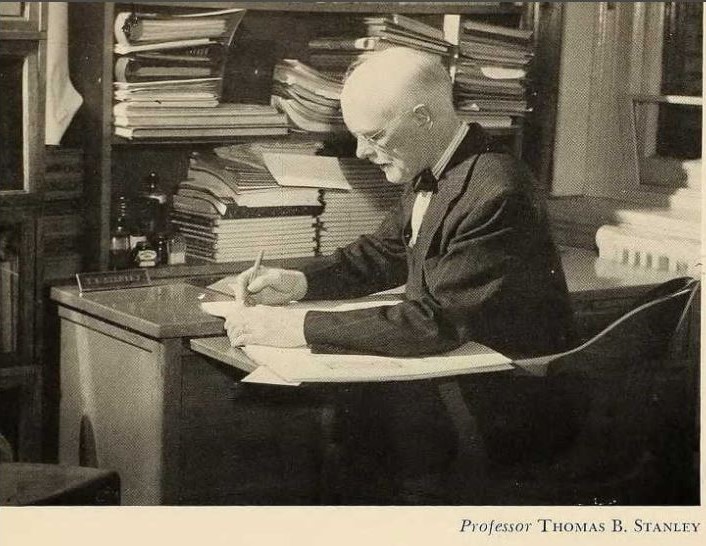
By David Heighway, Hamilton County Historian Emeritus
Thomas Blaine Stanley (1884-1965) was a Hamilton County native who began his career hoping to be an artist and ended by being known for his marketing expertise. He was in the first generation of business scholars to recognize that marketing was a skill unto itself. He also used his art skills to leave a unique collection of work.
Stanley was born in Noblesville where his father ran the telegraph office. He graduated from Noblesville High School in 1902 and, among other things, had been business manager of the school magazine, The Autocrat, in 1901. This experience would serve him well later in life. Although there are references to his artwork in the magazine, there are no actual illustrations by him. Possibly this was because he was at NHS at the same time as Worth Brehm and Hanson Booth, who both became quite famous later as illustrators. Stanley attended Herron Art Institute in 1902 and in 1906-8, and he is listed in the 1908 city directory as an illustrator.
Evidently, somewhere around this time, he had a change of plans about his career path. In 1911, he went to Earlham and graduated in 1913 with a B.A. in English. From there, he went to Illinois University and graduated in 1916 with an M.A., also in English. He taught at Illinois briefly until he was hired by New York University in 1916 to teach Business English at their rapidly expanding School of Commerce. Except for a short stint as Art Editor of the American magazine in 1927, he worked at NYU for the rest of his life.
By 1940, Business English had changed into Marketing. A subject that taught rhetorical skills for writing advertising copy naturally evolved into developing creative concepts for promoting products. This was the root of what would become the mindset illustrated by the HBO series Mad Men. Eventually, Stanley was known as Professor Emeritus of Marketing at NYU. He wrote two books on the subject – A Manual of Advertising Typography (1935) and Techniques of Advertising Production (1940).
He would come back to Noblesville on occasion to visit his family in their home at 10th and Hannibal Streets. The house is now gone, but there are stories that it still had the studio from when he worked as a local illustrator and that Stanley would give classes when he was home.
Throughout his career, he kept his hand in at art – doing projects such as designing the covers for the university magazines. He took an interesting step in 1920 when he created a business-oriented cartoon series for the magazine Advertising and Selling. It ran weekly from March to November, and the public reaction was enthusiastic. Businessmen wrote to the magazine asking for copies of the strip to post in the office and send to their employees. Although the reaction was similar to the modern “Dilbert” comic strip, there were no recurring characters, except for, occasionally, “Alfred the Ad Man”.
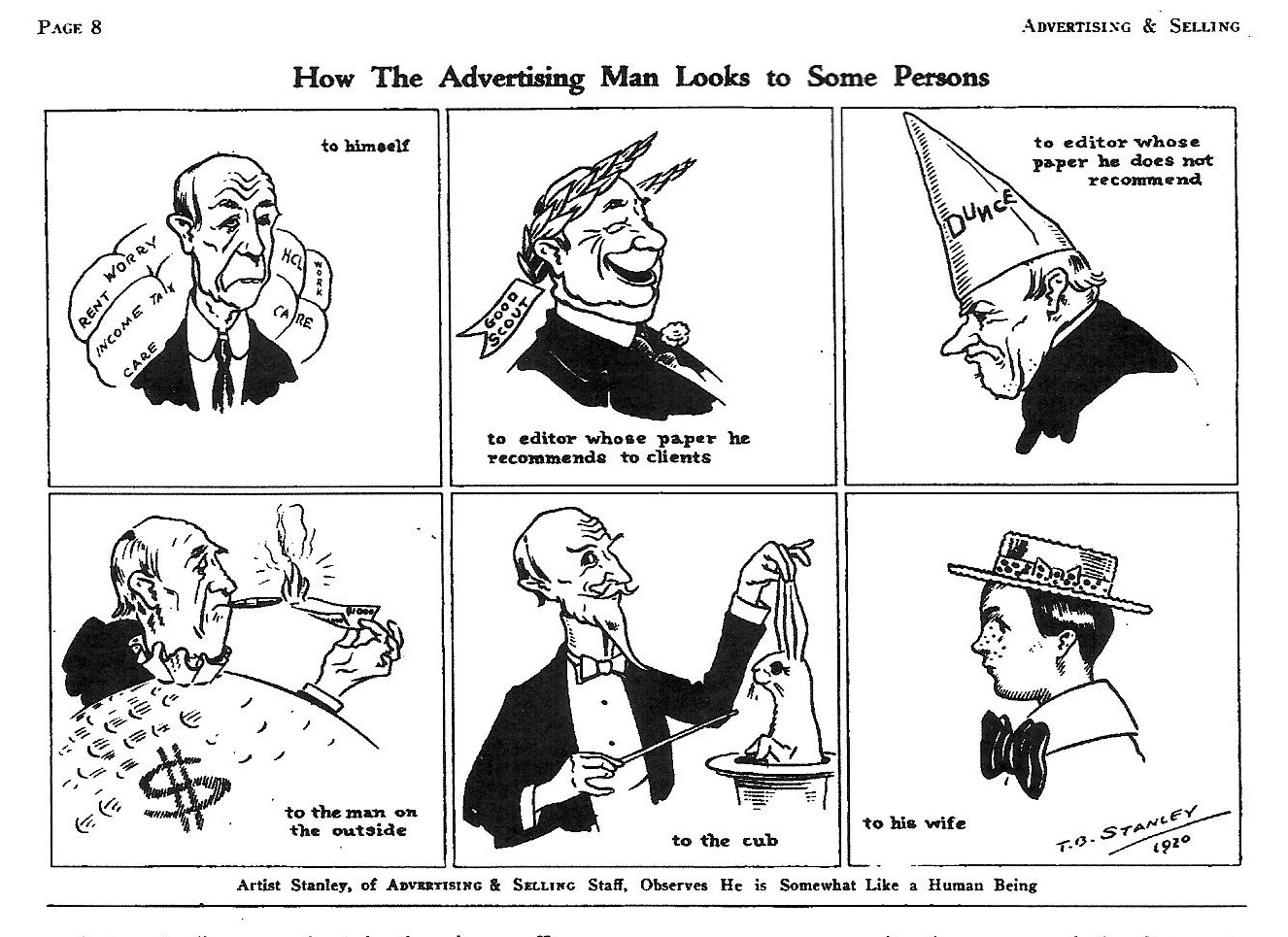
Advertising and Selling, June 26, 1920 Issue
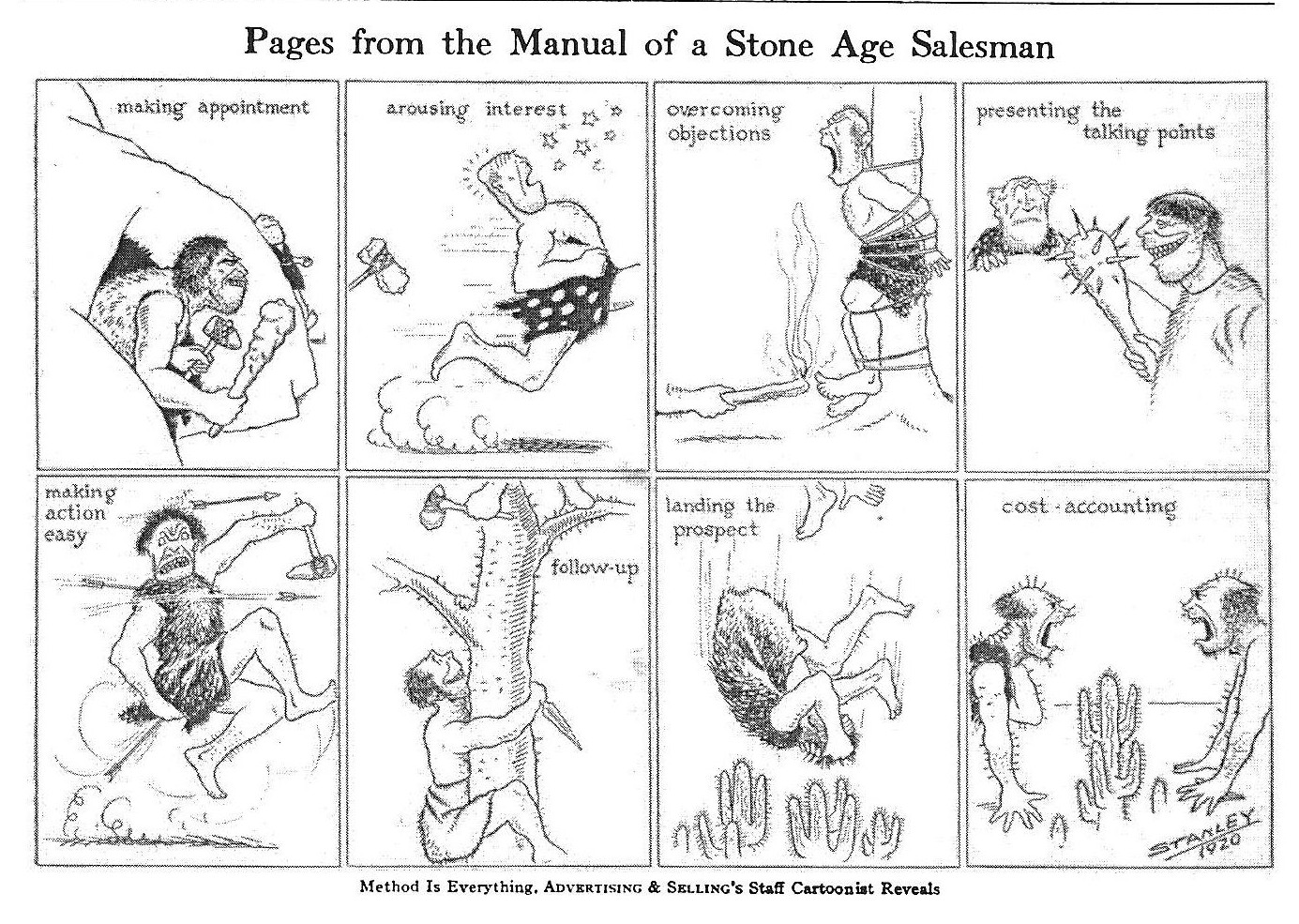
Advertising and Selling, June 28, 1920 Issue
The strip is an interesting look at both the business practices of the day and how they could be viewed humorously. Some of the strips are difficult to understand now since they were based on the popular culture of the day. But, it’s likely that our advertisements and the satire based on them will be just as incomprehensible a century down the road.