


By David Heighway, Hamilton County Historian Emeritus
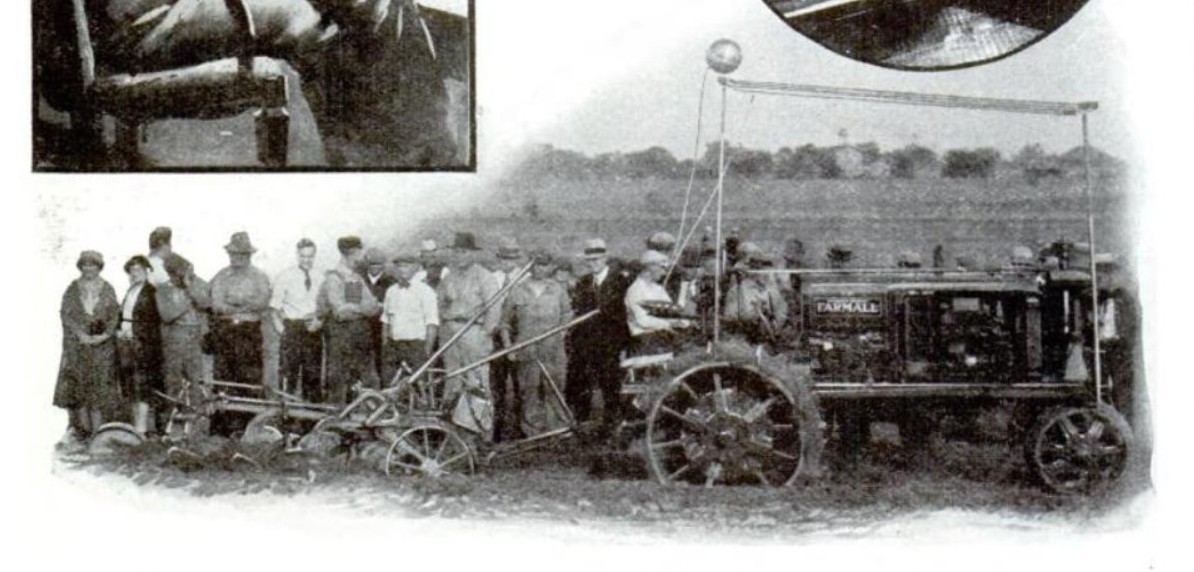
We think of driverless cars as some of today’s cutting-edge technology, but people have been experimenting with the concept for a long time. One such experiment on a Hamilton County farm in the 1930s attracted national attention. Although the vehicle was controlled by radio like a drone, rather than with artificial intelligence like today’s cars, it still seemed like magic to some of the observers.
The Noblesville Ledger, October 5, 1931
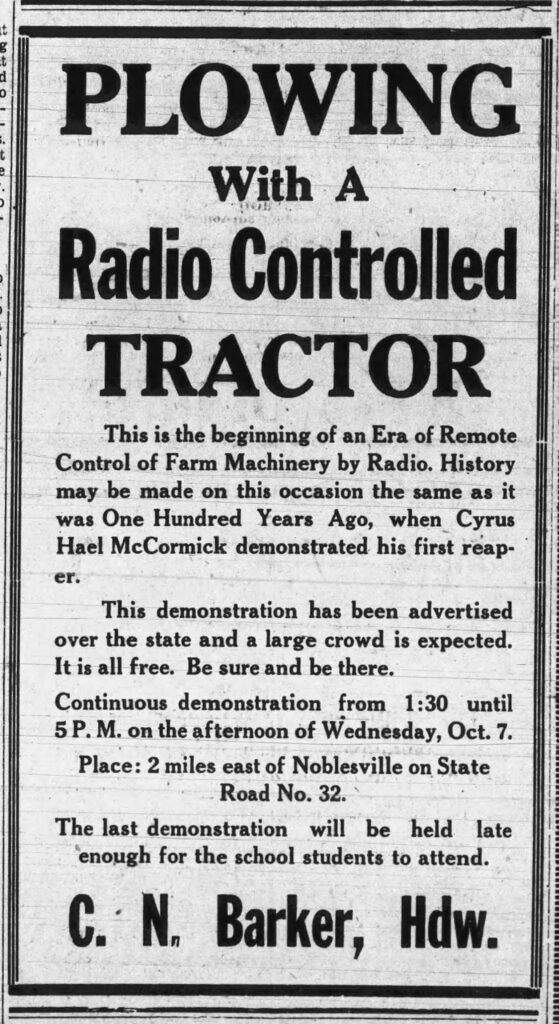
In the early 1930s, a man named J. J. Lynch was promoting radio-controlled vehicles. He hadn’t actually created the technology but instead took over the project from the original inventor. (The full story of J. J. Lynch can be found in “The Untold Story of the First Driverless Car Crash” by Brett Berk.) Lynch traveled to agricultural fairs around the United States to demonstrate the tractor and appeared at the Indiana State Fair in September of 1931. It was while he was at the fair that he was seen by Noblesville hardware store owner Clarence N. Barker, who apparently saw some potential in the system.
Barker had a farm east of Noblesville on present day 186th Street, and he offered one of his fields for Lynch to give a demonstration. He also offered to loan his Farmall tractor. Lynch agreed, and the demonstration was set for October 7. The Noblesville schools were let out to give the children a chance to see this startling new technology.
The equipment was crude by today’s standards, with a bank of 12 large batteries to control the mechanical systems on the tractor. The media articles describe the radio control mechanism as “telegraph keys”. There was one to blow a whistle on the tractor, ones to work the clutch and throttle, and one for steering (although it’s not clear how that worked). The setup was low-powered – the operator had to follow in a car and stay within 15 to 20 feet of the tractor. The tractor was hand-cranked to start it and then set off to plow a 30-acre field. It went off course a few times, but it completed the field and the demonstration was considered a success. Lynch predicted that, in the future, television would be used to monitor the tractor as it worked.
Popular Science article “Radio Signal Guides Farmer’s Plow” in February 1932 issue
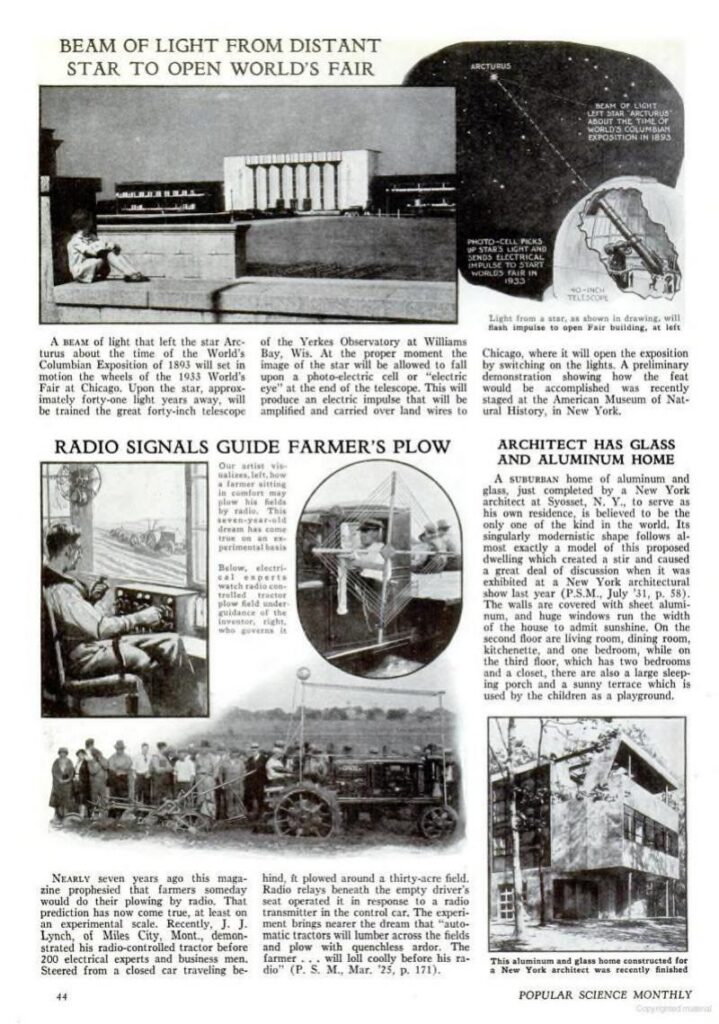
The Associated Press reported on the demonstration, and when the story was released on the wires, it appeared all over North America. It was even covered in a newspaper called the Guardian in London, England. Popular Science magazine had suggested the use of radio-controlled farm equipment as early as 1925 and, in an article in their February 1932 issue about the demonstration, said, “This prediction has now come true, at least on an experimental basis.” (Unfortunately, they forgot to mention that it took place in Hamilton County.) Photos were taken of the event and were evidently used for future promotions – copies can be found today found in the collection of the Wisconsin Historical Society and the Western Canada Pictorial Index.
There was strong local coverage as well. A Noblesville Ledger article on October 8 was headlined “History Was Made on C. N. Barker Farm”. The Indianapolis News quoted Noblesville School Superintendent O. T. Kent as telling the schoolchildren, “This may be an epoch-making day. … Perhaps you can tell your children and grandchildren that you saw the first tractor operated by a radio.”
However, Barker apparently never followed up on the demonstration. There is no record of any more high-tech experiments on his farm. He died in 1937 and is buried at Crownland Cemetery.
The Noblesville Ledger, October 8, 1931
As far as national interest in radio-controlled farm equipment went, while nothing ever became commercially feasible, the idea continued to be discussed and examined. The Noblesville demonstration was mentioned in an International Harvester booklet in 1934 for the Century of Progress exhibition, where they were running another version of a radio-controlled tractor. Lynch continued to promote his equipment until the 1940s, despite the crash of a driverless vehicle that injured several people during a demonstration in 1932.
Today, there are plenty of businesses in Hamilton County that work with drone technology. It’s good to know that over 90 years ago, we were among the first to experiment with it.